On Rushing
Bataille, Picasso, Goya, Abstractions, and Resolutions

It was New Year’s Eve and my boyfriend and I were on our way to see Marty Supreme at Alamo Drafthouse. Could life be injected with the times more than that? We were running late, and my eyebrows looked a mess. I grabbed my derma planer and tried to take off the protective top. It was stuck. In a panicked frenzy, I ripped off the blade, pushing it directly into my thumb. Blood began to spill out— first in elegant droplets, then, seeming to gain confidence from its accumulation, in a steady stream. We didn’t make the movie.
Later that day, our acceptance to an apartment was rescinded. I had written a wrong date on the application I had filled out in a hurry, and the landlord saw danger in my absent-minded inaccuracy. We dealt with the disappointment by taking a walk around the block, and I declared my resolution for 2026 would be to slow down. As meticulous as I can be about organizing my thoughts I am haphazard in the material world. I’m the kind of woman who needs to tell herself exactly where the keys live and be careful to return them to their home after every outing or they’ll end up in the fridge. Always pacing, always nicking myself, always grabbing the lid of a jar I didn’t fasten properly and watching its contents plummet to the floor. What would it take to slow down, to be present in each moment? Is this a matter of respect (for objects, for myself)? Is my rushing a symptom of some deep-seated flippancy? What is possible to make of a world that is blurred?
If rushing has its merits, they are aesthetic. In reading Bataille’s 1945 essay “Picasso’s Political Paintings” from Critical Essays Vol. 1, I learned the bombing of Guernica occurred in April of 1937 and that Picasso’s famous painting of the excruciating scene was exhibited at the Paris Exposition later that same year. The short timeline fascinated me, it felt intrinsically linked to the painting’s form. Is this the first painting to expose the gruesomeness of war in all its meaninglessness? Is our first confrontation with this an abstraction of greys? Picasso hadn’t visited Spain in years when the Spanish government commissioned a piece from him. He struggled to paint anything, but then the Basque poet Juan Larrea urged him to paint the very recent bombing, and we have to assume Picasso was moved by Larrea’s account of his homeland being destroyed (I’m imagining now Baudrillard in my head saying, “Guernica never happened to Picasso.”)
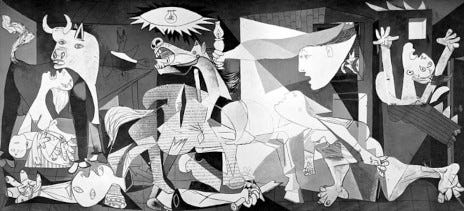
Paintings of battles and warfare are copious at every juncture in history, but they served an entirely different purpose to Guernica. They were typically commissioned years after a victory by the state to cement triumph, to write into history the glory of a king. Take The Battle of Trafalgar by Clarkson Frederick Stanfield, a 1836 rendering of a naval battle in 1805, or Velazquez’s The Surrender of Breda, a painting done between 1634 and 1635 of the 1625 Spanish conquering of Breda— both these works take the position that the violence they depict was justified as it resulted in great expansion. Guernica makes no such declarations. The urgency of the painting makes it incorruptible by history: whether or not the good guys win, the horror persists.
Bataille draws a throughline between Guernica and Goya’s The Second of May 1808, but praises Picasso’s work for being richer and more complex. This is because “Picasso doesn’t resolve the horror into a simple, fearsome defiance. It releases within him an excess that runs in all directions, drives the great pageant of life to extremes, spills out the unearthly content of things.” I’m inclined to think Guernica is in conversation with another one of Goya’s paintings, though, The Third of May 1808.
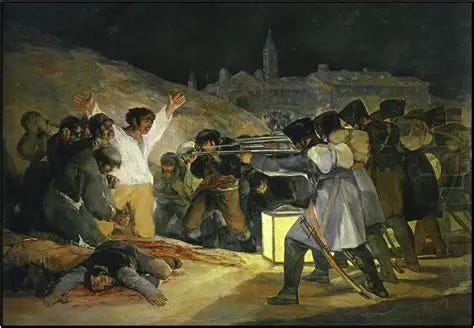
Here, the Romantic painter leaves behind his usual detailing, his flares and flourishes, as the painting gives off an almost impressionistic rendering of Spanish forces resisting Napolean’s fleet during the occupation of Madrid. In the 1948 essay aptly titled “Goya,” Bataille qualifies the technique of this painting as hurried, saying, “the anguish, the unhappy, hasty tautness of movement is a response to the impossibility of the subject: it not only goes as fast as possible, but as far as possible, never swerving from the goal, always pressing on further. It is free, […] and its freedom is a freedom in awakening us a little more to what produces anguish, to what we do not at all have the strength to bear.”
The Third of May 1808 was completed six years after the May rebellion— now centuries away— but its technique brings about an urgency that binds us viewers to the horrors of that day. What does Bataille mean when he says it is free? It is a freedom from representing the world as it is in favor of presenting the emotional content of it instead. Picasso luxuriated in this freedom, and the reason Guernica garnered such notoriety is precisely its emotional content, laid bare by its hurriedness, its abstraction, an excess of meaning that is typically only reserved for dreams (“trauma” is the German word for “dream,” and isn’t all trauma just that which renders reality illegible, dreamlike?).
Now let’s return to me, or the Giulia Bencivenga writing this delightful Substack. In rushing through daily tasks, am I treating them as if they were abstract concepts? Would that not make me like the waiter who acts out of bad faith from Being and Nothingness, he who puts on a show of being a waiter because he doesn’t like to think himself actually a waiter. What is more real, the computer in my lap or the feelings I have toward it? Do my rushed gestures come with an intrinsic defiance toward the quotidian? Hurriedness must be used with intent, it cannot capture the totality of form (unless you’re Mary-Kate Olsen, but that’s a different story). It is a stroke that can quickly corrupt.
Okay, now everyone wish me luck on keeping my word in 2026.